Author : Unzila Siddiqui

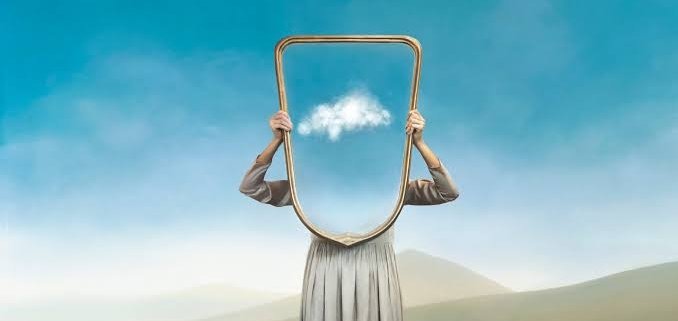
It has been a long time since we last spoke to the mirrors hanging on our living room walls. We stand before them daily, smoothing out the creases in our attire, applying fresh colors to mask the lines of age, and granting ourselves a reassuring smile before stepping out into the marketplace of the world. Yet, all of this remains merely a display of the exterior a carefully orchestrated performance for public consumption. We rarely pause to ask the glass a deeper question: what do the features of the human being hidden inside this vessel of clay actually look like? How bright is its true color, or has it been obscured by the heavy dust of compromise and expediency? The truth is, we have become so consumed by the act of presenting a curated face to the world that we have grown terrified of facing our own inner reflection.


The mirror of the soul is notoriously unforgiving. It pays no heed to rank, social stature, political clout, or the spotless elegance of one’s attire. It reflects a person precisely as they are in the eyes of the Divine, or during those absolute loneliest moments when the applause of the crowd dies down. The grand tragedy of our contemporary society lies in the profound chasm that has opened between our public personas and our private realities. We gather in assemblies to lecture on justice, our tongues spin refined pearls of culture and decency, and our pens write grand elegies to truth. But the moment we retreat into the private circle of solitude where no human eye can pierce our moral grandeur collapses like a house of cards.


A mystic once remarked, “If you wish to know the truth of your inner self, observe what you do when you believe no one in the world is watching.” This sentiment, despite its apparent simplicity, carries an ocean of quiet reproach. We live in an era where the benchmark for righteousness has dwindled to merely “not getting caught.” As long as our flaws remain veiled from public scrutiny, we are deemed honorable, intellectual, and credible. Yet, the moment the internal debris spills out, we realize that what we mistook for virtue was nothing more than the triumph of a well-maintained curtain. This duality has burdened our collective consciousness to such an extent that we now find ourselves yearning for genuine joy and true peace of mind.


If we closely observe the social landscape around us, a striking contradiction reveals itself at every turn. The very class entrusted with guarding the moral fabric of society often leaves us in deep despair when we glimpse their private corners. Individuals occupying positions of immense influence, tasked with shaping the destiny of the public, frequently possess inner worlds so constricted that there is only room left for ego, avarice, and self-interest. But is this grievance limited only to those in the corridors of power? It is not. This affliction has spread through our collective culture like an epidemic. Even at the grassroots level of our neighborhoods, we fall prey to this double standard. We are instantly ready to convene a court over the minor flaw of a neighbor, yet we dismiss our own gravest transgressions as a mere “necessity of the times.”


A major catalyst for this apathy is that we have stifled that faint, persistent voice of conscience which once checked our every misstep. Initially, when a person errs, the internal mirror clouds over, and a sharp pang of guilt is felt. However, when the act is repeatedly committed, the conscience becomes heavily rusted by rationalization, until wrongdoing no longer feels wrong at all. We have comforted ourselves by rebranding our falsehood as ‘discretion,’ our greed as ‘strategy,’ and our moral indifference as ‘maturity.’ It is precisely from this point of self-deception that the definitive decline of any civilization begins.


When we constantly live behind a mask, a subtle psychological toll is exacted upon our well-being. We begin to fear the truth, not because it is inherently dangerous, but because it threatens the delicate architecture of the falsehoods we have built around ourselves. We spend an exhausting amount of energy maintaining appearances, managing perceptions, and defending our public facades. In doing so, we lose the capacity for authentic human connection. Relationships become transactional, conversations lose their warmth, and empathy is replaced by cold calculation.


Reflecting with gentleness and empathy, one must ask: is this life truly meant to be squandered in such perpetual contradiction? Will we ever reach a point where we can look into our own eyes with absolute confidence and say, “Yes, I am the same within as I appear without”? The solitary escape from this crisis demands the quiet courage to practice self-reckoning. We must stop pointing fingers at others and instead begin the difficult work of wiping clean the internal glass that has become caked with the grime of hypocrisy.


No journey of transformation ever begins from the outside. Until the sun of truth rises within the realm of our own hearts, it is impossible for light to illuminate the world around us. Let us, today, discard the masks of convenience, peer deep into our own existence, and recognize the inner reflection that constitutes our true reality. There is still time to align our outer appearance with our inner truth—before the unsparing hand of mortality strips away our fragile disguises forever, leaving us standing bare before the court of history.
 

By Unzila Siddiqui

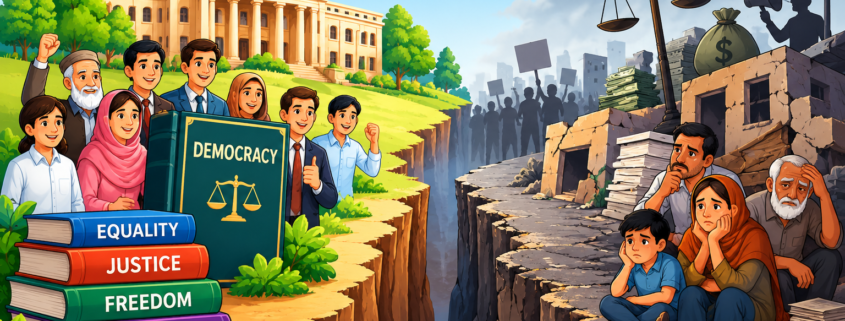
From high political corridors to local neighborhood tea stalls, few words resonate as frequently or evoke as complex a mix of hope and bitterness as “democracy”. Democracy is far more than a mere mechanism of governance; it is a profound philosophy anchored in public sovereignty, the protection of fundamental rights, and the creation of an equitable society. The true beauty of democracy lies in the principle that power stems not from a single ruler or an elite oligarchy, but from the ordinary citizen standing patiently in line under a scorching sun to cast a ballot and shape the nation’s destiny. Yet, when this noble ideal is weighed against our daily realities, a stark contradiction emerges. Grand claims of democratic ideals notwithstanding, the common citizen’s daily struggle for survival remains an unaddressed and haunting question.

Human history bears witness that the tree of democracy has always been nourished by the aspirations of the people. Its primary objective was to ensure that citizens hold the first claim over state resources—a true welfare state providing accessible justice for the marginalized, medicine for the sick, books for the child, and shelter and dignified employment for all. In literary terms, democracy is the art of healing collective human pain. Regrettably, over time, our national understanding of democracy has been reduced to a five-year electoral spectacle. During elections, the voter is briefly elevated to royalty, showered with promises and attention. Yet, the moment the votes are counted and power is secured, the public is promptly pushed back into the dark well of their pre-existing struggles.

A glance at our societal structure reveals an exhausting list of fundamental issues that have remained frozen for decades. Crippling electricity shortages, the absence of clean drinking water, overflowing sewage in residential streets, and relentless inflation have collectively broken the back of the salaried and respectable middle class. An ordinary citizen wakes each morning burdened by immediate anxieties: how to secure the day’s meals, pay school fees, or cover medical costs should an ailing parent or child fall ill. These fundamental struggles stand as a quiet indictment of any democratic framework where a ruling class enjoys opulent lifestyles while the general populace struggles for basic sustenance.

Politicians frequently argue that democratic institutions require time to mature and yield fruit. While institutional growth is undeniably a gradual process, should the passage of time serve merely as a test of public endurance? The essential pillars of democracy remain accountability and true public representation. When citizens elect representatives to parliament, they expect the struggles and grievances of their constituencies to echo within the highest legislative hall. Instead, parliamentary proceedings are too often dominated by partisan rancor, mutual accusations, and the hasty passage of laws designed to protect political self-interest, while the fate of the average voter remains unchanged.

This disconnect is further compounded by a widespread lack of basic education and civic consciousness. Democracy yields its finest results when voters are informed and capable of evaluating performance beyond tribal loyalty, caste, or emotional slogans. Historically, public access to meaningful education and political awareness has been neglected, keeping the populace confined within narrow boundaries. Until ordinary citizens fully understand their rights and civic responsibilities, choosing leaders capable of delivering genuine progress remains difficult. In literary terms, the lamp of democracy cannot burn with full brilliance amid the darkness of ignorance.

It has become a routine political habit to deflect responsibility by blaming previous administrations or structural flaws in the system. Such apologetic explanations no longer suffice to comfort a struggling public. Democracy is fundamentally defined by delivery—by its ability to provide tangible relief to the people. When a system fails to guarantee safety, justice, and basic necessities, its relevance fades in the eyes of the common citizen. This failure fosters widespread cynicism, which is the most toxic element a society can absorb. When people lose faith in law and governance, anxiety and instability take root, eroding the structural foundation of democracy itself.

To move forward, we must breathe authentic soul into the democratic framework. Democracy must transcend textbook definitions and rhetorical speeches to become a living, tangible reality reflected in the public’s standard of living. Rulers must step outside executive compounds and directly experience the pressures confronting everyday citizens. They must recognize that until a laborer receives fair wages before his sweat dries, until a farmer obtains just compensation for his crop, and until every citizen feels secure beneath the state’s protective umbrella, the democratic journey remains incomplete.

The true essence of democracy resides in constructive dialogue and dedicated public service. Political rivalry between government and opposition is a natural feature of democratic systems, but failing to unite on core public interests is a profound tragedy. Vital areas such as healthcare, education, and employment require an enduring national consensus that transcends political divides and puts human welfare above partisan gain.

Ultimately, the success of any political system is judged by how compassionately it protects its most vulnerable citizens. Democracy remains an ideal system, provided it is implemented in its true spirit. Bridging the divide between philosophy and reality requires no magic wand, but rather sincere intent, an empathetic heart, and sustained effort. The public has grown weary of unfulfilled promises and now demands meaningful action and lasting solutions. For democracy belongs to the people, and the people are its true and ultimate purpose.